FRUEHAUF : 100 years of Innovation

In 1918, August Fruehauf created the very first eponymous company “FRUEHAUF TRAILERS COMPANY” in Detroit, USA.

Discover the major innovations of the brand, from invention of the concept of the first semitrailer in 1914 to our involvement today in research into the vehicle of the future.

Invention of the semitrailer

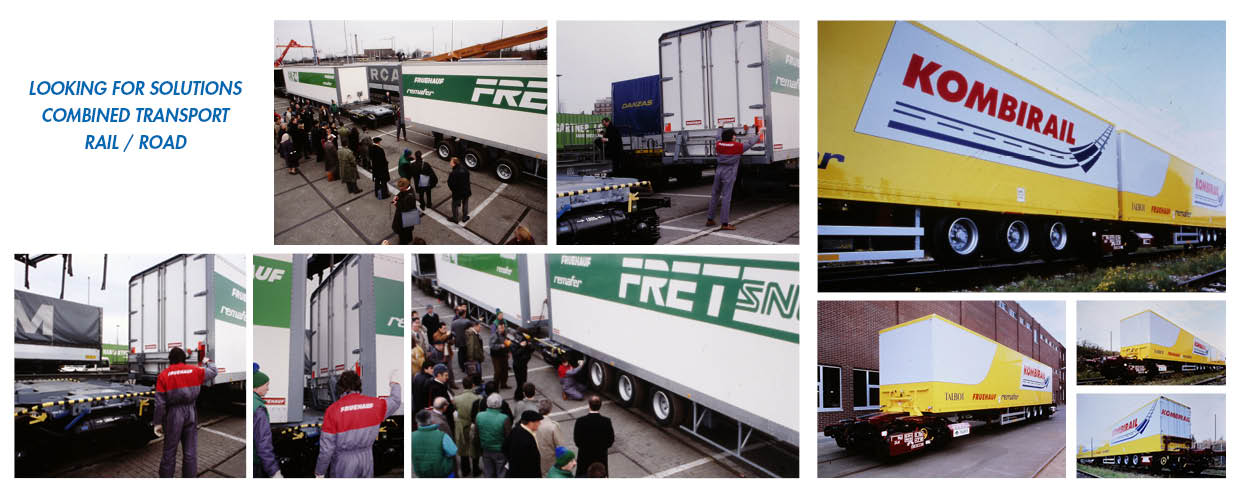
August Fruehauf (1868 - 1930) In his youth, August honed his skills in renowned workshops and was able to get into manufacturing all horse-drawn equipment. This path led him to make the quality of the work done and the materials used his watchwords and pride. In October 1890, August married Louisa Schuchard. The young couple moved to Detroit, the heart of the American motor trade at the time and founded a company. August gradually built up a reputation as an excellent blacksmith and manufacturer of high quality materials. Customers loved the quality of his work and the reliability of the equipment. LISTENING TO CUSTOMERS In 1914, Frederic M. Sibley Sr. was looking for a way to transport a sailing boat to his holiday destination and asked August Fruehauf to adapt a piece of equipment to his Model T Ford. August Fruehauf and Otto Neumann, his long-time collaborator, developed the initial concept. They manufactured a platform with sides high enough to safely transport the sailing boat and its accessories. On the front of the trailer, they installed the first special coupling compatible with the rear of the car. To do this they needed to remove the back seat of the Model T Ford. Starting with the idea that "a horse can pull more than it can carry", the first tractor and semitrailer articulated combination was born. This invention propelled road transport into the motorised era. FOUNDATION OF THE COMPANY IN 1918 Frederic M. Sibley and local entrepreneurs seeing it as an opportunity to save time and money flocked to order from August Fruehauf. Two years later, in 1916, his company had already designed three kinds of vehicles for road transport : trailers with one and two axles and semitrailers. Sales continued to grow quickly and in 1918, August Fruehauf founded the Fruehauf Trailers Company to satisfy increasing demand. Fruehauf's name quickly became associated with quality and customer satisfaction. The company owed its success to the constant expansion of the product range to meet the needs of all sectors of the economy. By 1920, the company had reached $1 million in sales. FIRST SEMITRAILERS IN EUROPE Only when the allies landed in Normandy in 1944 did the first FRUEHAUF semitrailers appear on the old continent, going on to be a huge success. 10 years later, Fruehauf Trailer Company had 9 production sites and 88 branches in the USA, Canada, Brazil and France and was one of the largest multinationals in the world. When he died on 11 May 1930, August left a thriving and prosperous company to his sons. August and Louisa Fruehauf The founders of the family business. The eldest son of August and Louisa, the second Chairman of the Fruehauf Trailers Company from 1930 to 1949. The youngest son of August and Louisa, the third Chairman of the Fruehauf Trailers Company from 1949 to 1958. Harvey Fruehauf Roy Fruehauf RELEVANT COMMUNICATION Harvey Fruehauf was the first to understand the importance of widely advertising the benefits of his father's invention. He started by convincing him to invest $28 in an advertisement in the American Lumberman periodical in 1915. This initial investment quickly paid off by generating sales worth $22,000 in a year. The monthly advertising budget quickly increased to $100 a month. The advertising slogan quickly demonstrated the value of a new means of transport designed by August Fruehauf. Little by little, the sales pitch developed and sales ensued. "A horse can pull more than it can carry" The first automatic fifth-wheel coupling When he invented the semitrailer, August Fruehauf created a preliminary coupling solution. Since the development of the first semitrailers, August Fruehauf invented an automatic coupling solution. The first automatic coupling When it is coupled, the tractor's fifth wheel pushes through and automatically raises the landing gear. He then began to research a more effective solution. In 1919, Fruehauf Trailers Company created the first automatic locking floating fifth wheel. Creation of the lift tailgate August Fruehauf was the first semitrailer manufacturer to introduce a hydraulic solution on road transport. From 1920, he equipped his semitrailers with a device for lifting the load inside the vehicles thus facilitating the work of the operators. The first torsion bar suspension Fruehauf introduced the first torsion bar suspension in the mid-1940s. This innovation allowed heavy loads to be carried with less stress on the axles, thus reducing tyre and undercarriage wear compared to traditional spring leaves. The first van With the invention of the van, transport companies could get into markets thus far inaccessible, delivering all kinds of goods quickly and directly to customers. The Fruehauf van has been continuously improved and adapted to each customer order and each application. Originally made from steel and wood, aluminium and stainless steel were quickly adopted to increase the capacity of these vehicles to great customer satisfaction. The first tanker The first tanker designed by Fruehauf was intended to transport flour. The concept was later expanded to the transport of milk and other liquid foods, then to fuel and gas. The tank is subdivided to secure movement of the load and enable different products to be transported. Available in steel or aluminium, insulated, pressurised or refrigerated, the tank significantly broadened the spectrum of products that could be transported. The first hydraulic cylinder tipper Taking advantage of the experience gained during work on the lift tailgate, Fruehauf's engineers had the brilliant idea of using the hydraulic cylinder to create the first tippers. As the tipping capacity was greater, the payload gradually increased by adding more axles. The first low-bed vehicles To transport heavy machinery and large installations, FRUEHAUF developed a low-bed high-capacity solution. As soon as they appeared on the market, Fruehauf low-bed vehicles could transport up to 40 tonnes, allowing deliveries to places until then inaccessible. The first refrigerated van August Fruehauf introduced the first refrigerated van semitrailers to be able to quickly distribute perishable foodstuffs on remote markets previously inaccessible and initially supplied by rail. With a capacity of 4 to 6 tonnes, these vehicles were originally used to transport ice cream containers. After loading, ice was sprayed through a hatch on the roof. The first shipping container The first FlexiVan combined Road-Rail transport solution was developed by Fruehauf for the NY Central Railroad. The wagon, equipped with a hydraulically operated rotating plate, enabled quick and easy transhipment of the van. Following the request of a customer and friend to design a container that would withstand the conditions of maritime transport but that could also be easily transported by rail and road, Fruehauf's engineers came up with a twist lock mechanism at the four corners of the container for easily lifting it and locking it on vessels, vehicles and trains. The first timber trailer To transport timber, August Fruehauf was faced with the need to carry increasingly heavy loads, especially for transporting logs. The engineers therefore developed an ultra-lightweight structure, comprising only one rear twin mount tandem undercarriage connected to the hitch platform by an extendible structure, easily adapting to different lengths. The first large road trains Fruehauf was the first manufacturer to design road trains comprising carriers or tractors and semi-trailers and trailers. These new trains doubled and sometimes even tripled the payloads transported. FRUEHAUF INNOVATIONS Thanks to the various Fruehauf Trailers Company inventions, entrepreneurs were finally able to deliver their goods quickly to markets up until then inaccessible because of a lack of suitable means of transport. AT THE ORIGIN OF A NEW INDUSTRY In less than half a century, road transport had become a key factor in the development of the US economy, representing 10% of all jobs.

FRUEHAUF FRANCE

FRUEHAUF IN FRANCE Fruehauf's establishment in France was part of the international deployment of Fruehauf Trailers Company. At the end of the Second World War, subsidiaries were set up in various European companies, including in France from 1946 In 1946, Fruehauf France began importing its first semitrailers from America. At a time when post-war reconstruction was in full swing under the Marshall Plan, orders continued to build. In 1949, Fruehauf S.A. got its own design office, which adapted vehicles to the needs of the French market and developed new products. Sales rocketed. 10 years after it was founded, Fruehauf France already had a 30% share of the national market, leading to the creation of a large, modern production plant. 1945 Raoul Massardy started selling Fruehauf semitrailers left behind by the allies after the war in Toulouse. The company moved to Toulouse where Fruehauf France technicians designed and fully manufactured new semitrailers. Production reached 90 vehicles a month, representing 30% of national demand. 1946 Fruehauf S.A. was founded in France, with the establishment in Colombes of the first workshop for assembly of tankers imported from the USA. 1949 1952 The 7,600 m2 Viry-Châtillon plant opened to respond to growing demand. 1956 1958 The Auxerre plant officially opened, representing 15,000 square metres of production surface area. Production of shipping containers began in Auxerre. 1963 The headquarters and sales departments were set up in Ris-Orangis. In the same year, production reached 1,130 vehicles. 1968 1975 The Fruehauf France workforce reached 2,000 employees for total production of 700 vehicles and 800 containers per month. Construction of the Maubeuge plant got under way (160,000 square metres). 1972 Fruehauf acquired the Bourges and Bernon plants and took over the company FAR. 1982 The holding company SESR was created, grouping together FRUEHAUF France and its European subsidiaries. One year later, SESR became the European leader and in 1999 became General Trailers France. Benalu was acquired by Fruehauf. 1987 Fruehauf and Benalu were acquired by Caravelle in March 2004, following bankruptcy of the General Trailers Group. Fruehauf expanded further, developing sales and significantly increasing its market share from 20 to 30%. New vehicle ranges were launched: steel tippers and centre-axle trailers. 2003 2014 Collaboration with WIELTON, a Polish semitrailer manufacturer, which acquired 65% of the capital, giving it a European dimension. CITY vehicles were launched. 2015 A full range of aluminium tippers was launched. 2016 2017 URBAN vehicles, low-bed trailers and semitrailers launched. Fruehauf became the Group's centre of expertise in the manufacture of box trucks. 2018 Fruehauf celebrated 100 years of innovation. Innovation borne of participation Continuing the legacy of Fruehauf Trailers Company, FRUEHAUF continues to develop numerous innovative solutions. Staying faithful to the principle established for new products, developments are defined in close collaboration with customers and users who are experts in their fields so that they meet each of their needs perfectly. Research and development centre Innovation involves the ongoing search for new features, new and better products and new transport solutions. FRUEHAUF has modern and powerful development means. The Development Engineers use the latest tools, 3D development using finite element calculation constraint simulators. To ensure total reliability of the new solutions developed, FRUEHAUF uses the most powerful, most modern test centre in Europe, officially opened by the Group in 2016. It can simulate, at full scale and accelerated, 10 years of use or 1 million kilometres in just a few weeks. FALCON - The future at work Advanced research project FRUEHAUF is involved in the "FALCON" (Flexible & Aerodynamic Truck for Low CONsumption) project, an advanced research program on the vehicle of the future at the cutting edge in terms of innovation, aiming to improve the energy efficiency of road trains and therefore reduce their fuel consumption and CO2 emissions. The FALCON project brings together a consortium of 13 French partners who are specialists and leaders in each of their fields for new predictive driver assistance and energy management features. The goal is to put into circulation at full scale between the end of 2018 and 2020, a laboratory demonstrator assembly combining cutting-edge technology in every field and aimed at anticipating future regulations on CO2 emission reductions.